Friday, July 6, 2012

Fantastic Farmer's Market Finds

It drives me crazy that my local farmer's market doesn't open until mid-June. But then when it does open, I walk through turning up my nose at things labeled "green-house grown." I want fresh and local, and I want it now! Which means I have to be patient. Luckily I was able to bring home some pretty good finds yesterday and while I've been considering what to do with them, I thought of some handy tips for shopping at a farmer's market.
  • Try new things. If you aren't sure what something is, it's OK to ask the purveyor how it is generally used or what dishes it might complement. My best suggestion for trying a new vegetable is to first saute in olive oil with a little bit of salt and pepper; that way you'll get a sense of the true flavor before tossing it in with other veggies and seasonings. You'll be able to figure out yourself what it would pair well with!
  • Bring cash and ask for weights. I'm not great at eyeballing what a pound of squash might look like, so it can be tricky to know how much to ask for when items are sold by weight. Yesterday I only had $3 left by the time I reached the final booth and the pattypan squash were $2/lb so I asked the woman for $3 worth. I ended up with a whole lot more squash than I actually wanted! But that's OK because it's delicious and I can share with friends. But I probably would've been better off asking how much a couple of small squash would cost to begin with.
  • It's in season if there is a lot of it. A few years ago I was so excited that a stand had eggplant for just $1 each. Then the next summer I had a recipe in mind and went to the farmer's market all ready to purchase them only to find that I was several months too early for eggplant at such a cheap price. In the beginning of the season you're likely to find lots of lettuce and other leafy greens; tomatoes and other more colorful vegetables come a bit later.
Pattypan squash from the farmer's market
If you're looking for motivation to try a new fruit or vegetable, try doing an internet search for the health benefits. For example, I just got the newsletter from SCAN, the Sports, Cardiovascular, and Wellness Nutrition subgroup of the Academy of Nutrition and Dietetics. In it, I learned about the aerobic exercise performance enhancing qualities of beets, rhubarb, and arugula. One study showed that eating 7-8 beets 3 hours prior to performance can improve performance in addition to improving circulation! Another study showed that consuming tart cherries made for faster muscle recovery. So if you're looking for performance benefits or just looking for something delicious, head to your local farmer's market and get cooking.

Tuesday, July 3, 2012

So You Think You Eat Healthy?

It's something that even my soon-to-be dietician friends and I say to each other: "I'm eating healthy, but I'm not losing weight!" We have studied very meticulously the specific reasons for this, but complaining about it always makes you feel a little bit better. For those times when it seems like there's just nothing you can do, no way to possibly eat healthier, here are some reminders...

Just because it's "healthy" or "better" doesn't mean you can throw portion control out the window. With the exception of some raw or steamed vegetables, even healthy food in large portions will give you a lot of calories. I know I personally give myself a bit of a pass to eat a little bit too much if I'm having whole grains with vegetables and a lean protein. But especially with foods like rice or pasta, whole grain or not, you should still only be having about a 1/3 cup size portion.


Eating healthy without exercising isn't enough. If you are a person who normally exercises and then stops, just eating healthy will not make your body feel the same. Also make sure that you're not overcompensating for hard workouts when you eat afterward; calculate calories burned and consume equal or less, but not more.


Your body has a "set point" where it likes to be. This can be the hardest point of all to remember. If you're trying to lose weight and are doing it in a safe, healthy way but nothing seems to work, remember that your body is very happy right where it is and might be fighting your efforts. Remind yourself that you're doing the best that you possibly can for your body and that while you might not be losing weight, you're likely preventing a host of diseases both short term and long term by eating clean, unprocessed foods, whole grains, and super nutritious veggies.

Saturday, May 19, 2012

A Sneak Peek at the Copenhagen Marathon Expo

Today I had the opportunity to explore the Copenhagen Marathon Expo! The race is tomorrow and while I won't be here to watch the 12,000 or so runners, I didn't want to miss my chance to see the expo since I've spent quite a bit of time at marathon expos in the states. I was mostly curious about the sports nutrition products that are being marketed in Europe and got some great photos and information from vendors, as well as several samples to bring back home to try. However, that information requires some additional research. Time (as well as internet access) is precious at the moment so I'll just post one photo and the promise of a post regarding European sports nutrition, to come. If you're curious about my trip to Denmark, with most of my time spent eating and drinking rather than being active, check out Mother and Daughter Spiser.

In Danish, "Pace Setter" translates to "Fart Holder"


Sunday, May 13, 2012

Metabolic Armband Post #2!

Last time I promised to post the results of wearing a metabolic armband while handing out bars to runners at the expo, handing out numbers to runners at the expo, and watching runners run the marathon! And here it is. [Good news: I am now the proud owner of a fancy pants metabolic armband so expect more posts like this to come!]

Day of working at the marathon expo (7am-7:30pm): 2830 calories burned (3733 calories for the entire day). Clocked in almost 10 hours of “moderate” physical activity which is much higher than a normal day (see image).

The amounts of moderate physical activity (brown) and vigorous physical activity (yellow) I had from working at the expo

Handing out race numbers (12:30-6): 700 calories

Biking 15 miles of the marathon course: 363 calories
Watching people run 26.2 miles: 750 calories (and cheering, of course!)

Thursday, running for 30 min: 296 calories
Afterburn 60 minutes: 139 calories

Saturday, biking 15 miles: 255
Running a 5K (26 min): 242
Afterburn 30 minutes: 90 calories
The graph of calories per minute when biking (8:00am-9:15am) and running a 5K (10:00am-10:26am)

Unfortunately the afterburn results were not very scientifically accurate so I'll be trying out more of those types of tests soon. For now though, I'm off to Denmark... I'll be doing research for a book about eating, so I've got my running shoes and metabolic armband packed and will be reporting to you from there!

Monday, April 16, 2012

"Wear as few clothes as decently possible..."

Marathon runners coming through!
So said an e-mail sent to runners who qualified for the Boston Marathon this year. The weather in Boston has been fairly cool recently. However, today on Patriot's Day (aka BOSTON MARATHON DAY), it reached almost 90 degrees. I've spectated at races that have been unexpectedly extremely hot  and it's been a mess: officials telling runners part way through that the race was shutting down and they should stop running, runners not listening to them and continuing to run despite the removal of services like water and medical support. Not a good idea. I was impressed by the way that the Boston Athletic Association handled this year's heat wave. A few days before the race they decided to give runners the option to defer until next year if they didn't feel safe running in the heat. They advised people who had never run a marathon before not to run (aka the charity runners because all other runners had run at least one marathon before to qualify for Boston). If you did decide to run, they advised that you wear as little clothing as possible. They added mist tents, more water, and cooling stations inside buildings like churches and schools.

My favorite long-run fuel; strawberry Clif Shot Bloks
The Boston Marathon weekend is always a fun one for me and this year was no different. I spent Friday and Saturday working in the Clif Bar booth at the marathon expo. I love chatting with runners about how to incorporate Clif products into their training and racing plans and hearing people's stories about their favorite flavors or when a Clif Bar saved their life (you'd be surprised how many people have a story like this, often about a hiking trip). Then on Sunday I volunteer at the expo for registration and get to give runners their number and answer any questions they might have about the course, the buses in the morning, etc.

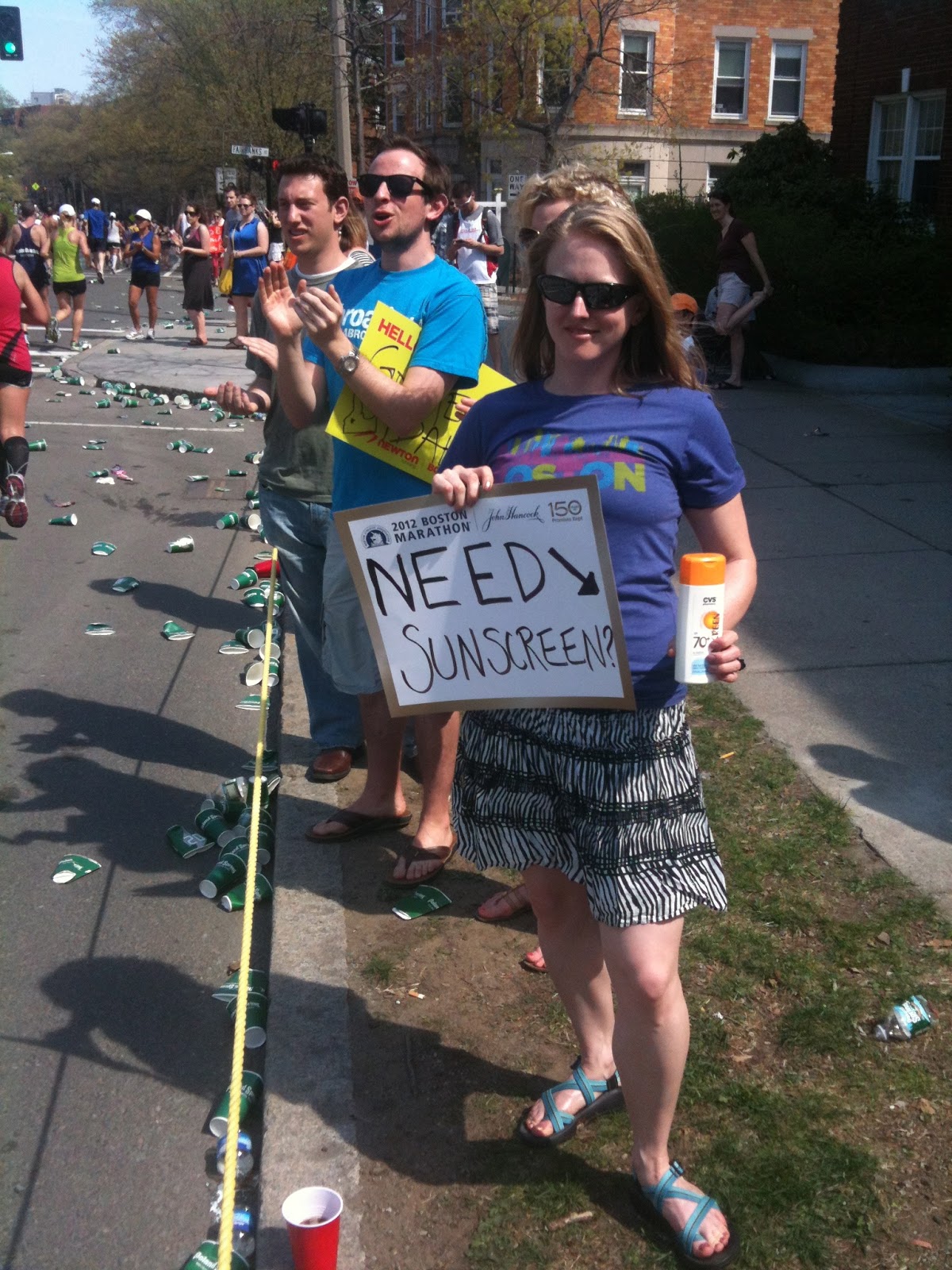
Then comes the day itself... Marathon Monday. There are always masses of bikers that wake up early and cycle the 26.2 miles to Hopkinton and back. I've never felt quite ready enough to do that in mid-April but I did bike 7.5 miles of the course out and back this morning, covering Heartbreak Hill and getting to Wellesley and back. It was fun seeing all of the spectators getting their chairs set up, seeing the volunteers prepping the water station, the kids writing on the streets with sidewalk chalk. After the bike ride I got to relax and cheer on the 27,000 runners from mile 23. I gave out sunscreen, my friends gave away free popsicles, and we helped a runner or two who needed some extra support.
Always trust a pale girl to bring the SPF 70 to the party

All-in-all it was an exhausting weekend - and I didn't even run the marathon! But it was well worth it. If you're curious about how many calories working at an expo, biking part of the marathon course, or cheering for hours can burn, stay tuned for an upcoming post because I had my metabolic armband on through it all... And if you're interested in trying to qualify for Boston, the guy behind No Meat Athlete has a new business called Run Your BQ (Boston Qualifier). Good luck!

Tuesday, April 10, 2012

What's In What You Eat?

Confession: I'm stealing this post idea from Hungry For Change, or Take Part Food as they're calling themselves these days. They posted this clip from SNL about "Almost Pizza" and I thought it was worth passing along:


Have you thought recently about what exactly goes into the food that you buy prepackaged? Something like pizza, you'd assume would have the typical crust ingredients like flour, toppings like cheese, veggies, etc. While it might not be able to walk under the fridge like the one in the clip, take a look next time you're in the freezer section; you'll find ingredient lists that read like a novel.

And while we're on the subject of frozen pizza... there are redeeming qualities to some frozen pizzas such as the calcium from the cheese, the vegetables (if there are vegetables), the iron from the meat. But pizza should only be a "sometimes food" (as Elmo would say), not an "anytime food" because in addition to those redeeming qualities you'd be hard pressed to find a frozen pizza that is not loaded with saturated fat and sodium; and that's if you only eat what they deem is one serving. For example, the Freschetta Three Meat Medley Pizza considers 1/5 of the pizza a serving and in that one serving you'll get 930mg of sodium (~39% of your daily allowance) and 7g of saturated fat (~35% of your daily allowance). So if you eat two or three pieces... you can see where I'm going with this. But if you want to eat frozen pizza once in awhile, go for it - just try to get the thin crust style with veggies. And in case you're wondering, there's plenty of white flour and calories in the pizza, so you can bypass those that come with bread sticks, wings, or cookies in addition to the pizza (YIKES!).

UPDATE: Just saw on the news that in the UK Pizza Hut is unveiling pizza with a hot dog stuffed crust. Thoughts?

Monday, April 9, 2012

Finding the Right Fit

Does your bike fit you? Chances are if you can move the seat post up or down until your feet reach the pedals, your answer is yes. But have you ever actually gotten a bike fit to you? Bike fittings can be pricey, but they can save you a lot of pain throughout the season. A few telltale signs that you might need a bike fitting are: a sore lower back, tight shoulders, numbness in feet or hands while biking, and knee pain. Bike fittings range from the basic, where a trained professional will hold a string with a weight up to your hip in order to make sure that the positioning is correct, to the extremely advanced which utilize cameras and computers.

I was lucky enough to get a glimpse of this fancier type of fitting a few weeks ago at the Multisport Expo. Wheelworks, the bike shop that sponsors my triathon team, was demo-ing the Retul bike fitting. According to the website, "Retül technology is a cycling-specific motion-capture bike fitting system designed to provide qualified bike fitters highly accurate and comprehensive bike fit data. The system incorporates three-dimensional measurement, immediate report capability, and a millimeter-specific digitizing tool to provide the most accurate dynamic fitting solution in the industry."

My experience was fun; the trained Wheelworks employee first stuck little velcro dots on some specific points on my body (shoulder, elbow, wrist, hip, knee, ankle, etc), then velcroed the LED markers onto those dots (markers were connected to each other and attached to a battery pack). A few feet away was a sensor bar. The fitter could then look at his laptop and gather all sorts of data about my fit as I pedaled. I got to see an image of myself as a stick figure, with each LED marker showing up on the screen and little lines connecting those dots. I also saw an image of my knee strokes; the further apart the two lines, which represent your leg pushing down and pulling up, the worse your form. My lines were very close together which indicated that I don't change position much from the upstroke to the downstroke.


It turns out my fit is pretty good already (not a big surprise since I don't have much pain when I ride) so I didn't need too much tweaking. He did suggest a shorter handle bar in order to get a better angle when I'm riding with my hands near the brakes (as in the picture, above). He also suggested that I buy a foam roller since it hurt a lot when he pushed into my hip trying to find the specific area of my hip he needed to place the velcro.

Spring is a great time to get a tune up and fit before beginning to log serious miles on your bike. If you'd like a retul fit and you're in the Boston area I highly suggest Wheelworks. The retul website has a function where you can search for certified fitters in your area. Or, if you're thinking of something a little less fancy, call your local bike shop and ask if they have any fit specials going on. Your body will thank you!