Showing posts with label eating habits. Show all posts

Tuesday, January 28, 2014

What's Getting in Your Way?

As I was rinsing off the salt-crusted soles of my running shoes tonight, I realized how warn down they are. A quick calculation and I realized that I've probably been wearing the shoes longer than the recommended 300 miles. I also remembered that every time I've put them on recently I've been a little bit grumpy about the way that they feel. Have they ever explicitly stopped me from going out on a run? No. But "old, warn shoes" are one thing that I could write in my list of the barriers that I feel get in my way of being as active as I could be.

What do your barriers look like?
In nutrition counseling we often talk about barriers. Part of being a successful dietitian is helping people to overcome or at least recognize whatever barriers they might have getting in the way of healthy eating. This could be a practical barrier such as lack of grocery stores with fresh produce or it could be something more internal such as feeling sad lately and feeling the need to find comfort in food.

Is there something that you're having a hard time accomplishing? Try making a list of barriers and potential solutions. Here's are a few examples - the first is one of my personal barriers and others I've drawn from patients.

Goal: run more often during the week
Barriers: cold weather, uncomfortable old shoes, darkness
Ideas to break barriers: put together a chart of outside temperatures with appropriate clothes that will keep me warm, buy new running shoes, find friend to run with consistently after work

Goal: eat more vegetables each day
Barriers: fresh produce just goes bad whenever I buy it, vegetables are hard to cook and expensive
Ideas to break barriers: stock freezer with selection of frozen vegetables that I know I like, find Pinterest boards featuring easy vegetable recipes to bookmark for trying each week, buy produce with recipe in hand on the day I know I have time to prepare it to avoid spoilage

Goal: lose weight in order to better fit into clothes
Barriers: gym membership is expensive, family doesn't like 'health' food, low motivation
Ideas to break barriers: find a friend to go for walks with outside on a consistent schedule, try making current favorite family meals using healthier ingredients, put sticky notes with inspirational quotes on car dashboard to remind myself of goal

These are just a few ideas of ways to get into the mindset of breaking through barriers. If you can think up some ideas for overcoming your own barriers, try writing them down. Even if you're not ready to take action yet, looking at your list of solutions can motivate you to take small steps in the direction of your goal! Now I'm off to buy some new running shoes...


Monday, December 16, 2013

Good Advice from England

This is a cute and creative video showing how our eating and living habits have changed over time and how that can affect obesity rates.


Thursday, September 26, 2013

Indulgences: "Permissible" or Not?

I read an article recently in the Wall Street Journal that conveyed how more and more companies are creating snack foods out of "healthy" ingredients because consumers are looking for "permissible indulgences." For example, salty fried chips made from sweet potatoes rather than white ones or a  "snack" made of 100% seaweed sheets.

Being a person who craves salty and crunchy, I've tried a number of these products. Seaweed seems like such a great snack food! Until you realize that you just paid at something like $1.00 per wafer thin sheet. True, it was healthy, but the vitamins and minerals it gave you probably would've been cheaper in some other whole form of vegetable and you would've stayed full longer to boot.

I've also fallen victim to items like vegetable chips (usually potato chips with a little bit of color added from other vegetables) and those amazingly delicious crunchy vegetable slices which often don't say, but always are, deep fried (which does make them delicious!).  Sure, they're dehydrated before they are deep fried, but I personally used to always stop at the fact that they're dehydrated thinking that the wonderful food production companies had found a way to extract liquid from vegetables and thereby make them crunchy (without then frying them in oil).

Looks like vegetables, tastes like (and is) fried, salted vegetables (sort of like a potato chip!)
Now, when I say "fallen victim" I don't mean that it was bad to eat these foods. As we try to teach people who need help normalizing their eating, foods are not "good" and "bad." What I think we can classify as good or bad though is the intention behind eating something that is marketed in a certain way, especially if words are used to make it seem healthier when in reality it is not. Do I think that the crunchy vegetable packing needs to say "you may as well eat potato chips" on it? No. But I think that the preparation method should be made explicitly clear by stating, for example: Deep fried green beans, carrots, and beets instead of: Garden Chips. That way the consumer can see that, think to themselves "this might not be healthy enough to become an everyday snack but it looks delicious so I'll try it knowing that it is probably not a magical alternative to an unhealthy snack."

An indulgence should be just that - something that you crave, something that you want. If you have to put the word "permissible" in front of it, that gives control not only to the food but also to the food production companies who want you to think that their product is more permissible than others. Chances are if you're thinking to yourself that something in a permissible indulgence, it's not really an indulgence at all. I've read that for some people, if they deny themselves the food item that they really wanted, they'll end up eating even more of the alternative choice because it will never fully satisfy them in the way that the original item would have; they then end up consuming more calories and being unsatisfied.

Monday, August 27, 2012

Good, Nutritious, and Cheap: Can it Be Done?

Before starting my dietetic internship in a couple of weeks, I have to complete an assignment where I eat for three days with the budget suggested by the USDA Thrifty Meal Plan. Based on my age and the fact that I only cook for myself, that will give me about $19 to stretch for three days. Oh, and I have to attempt to get in all of the suggested amounts of macro and micro nutrients with that money. I'm actually really looking forward to the challenge and have been contemplating various meal combinations over the past few days.

Today I ran across a link to this site, the Environmental Working Group's Good Food on a Tight Budget. While eating for cheap and still getting nutritious food is going to be hard enough on its own, it's interesting to think of the added challenge of also picking foods that have the fewest pesticides or the least amount of added chemicals. Take a look at their lists of good food on a tight budget and see if it inspires you to make a change in the way that you grocery shop. And if you have any suggestions for my three days of eating with a budget, let me know!

Monday, February 20, 2012

Full Up on Plant-Based Foods

None of us are sure exactly how it started - we were running stairs at Harvard stadium so I could track how many calories I was burning for my metabolic armband post. Someone mentioned that several people he knew were doing cleanses recently, I shared my opinion about the danger of cutting macronutrients out of your diet, and the next thing you know, the three of us were on a two-week long vegan cleanse*.

This was a lot easier for me than it was for either of them. I had already cut red meat and pork out of my diet and was a huge fan of tofu, legumes, and other vegan-friendly food products. Dan has a meat-share (like a CSA but with locally-raised meat) and Chris's breakfast routine every day includes two eggs. We sat at brunch that day after running the stairs eating eggs (me) and plenty of breakfast meat (them) going over what could and could not be eaten during these two weeks. Chris asked about bread (normally OK but check the package just in case) and we went over easy options for cooking at home (make sure to plan ahead) and eating out (Mexican and almost any type of Asian cuisine are the most likely to have options).

We all came out of it with mixed results, Dan making it the full two weeks despite his co-workers tempting him with copious amounts of Valentine's Day chocolate. Chris stopped early in order to get back to eating meat prior to joining Cross Fit (huge proponents of the Paleo Diet) and I did fine except for accidentally eating a handful of Cheetos halfway through the second week.

People often assume that you'll lose weight if you stop eating animal products, and I'm sure that a lot of people do (in fact, Dan did lose weight during the two weeks). For me though, I still ate just as many calories as I normally do, maybe even more because I constantly had a bag full of snacks with me in case I couldn't find any while out. It seems that many think of a vegan diet as being sparse, and in fact I've had people tell me that you "can't get full" on vegan food. True, there were times during the two weeks that I would've felt more full if I had been able to melt cheese on top of whatever I was eating, and I did get tired of the taste of soy milk, but besides that I ate some of the most delicious food I've had in a while. So for those who think of vegan food as nothing but bland tofu, mushy brown rice, and rubbery meat-replacement products, here were some of my favorite meals from the past two weeks....

Breakfast
Frozen hashbrowns sauteed in olive oil with wilted spinach, chipotle salsa, and lentils.
Whole-wheat tortilla with peanut butter and banana.
Steel-cut oats with maple syrup and walnuts.

Lunch
Whole-wheat tortilla filled with: brown rice, fire-roasted corn (comes frozen from Trader Joe's), avocado, cilantro, lentils, chipotle salsa.
Spinach salad with garbanzo beans, roasted red peppers, marinated artichokes, tomato, cucumber, and tabouli.
Whole-wheat tortilla filled with: white-bean hummus, chopped tomatoes, baby spinach, and falafel (frozen, again from Trader Joe's).

Snacks
I love Meatless Primal Strips and also ate plenty of my usual snacks (almonds, Luna bars, bananas, veggies and hummus).

Dinner
We had some great meals out including Grasshopper, an all-vegan Asian restaurant nearby, and True Bistro, an upscale vegan restaurant in Somerville.

As I mentioned earlier, Valentine's Day happened to fall during this two-week period and lucky for me I have a very understanding boyfriend who didn't mind helping me cook this delicious recipe for Polenta Lasagna with Portabellas and Kale that night. I was also helping out with data-collection in a school cafeteria on one of the days and after smelling lasagna all day had an intense craving. Fortunately, I was able to find this recipe which substitutes tofu for ricotta in a traditional lasagna and it really hit the spot!
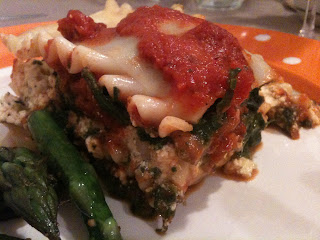
Vegan lasagna: healthy, filling, and delicious!
All-in-all it was really interesting to go vegan for two weeks in order to see all of the challenges that people can face. It made me value clearly-stated food labels and I did end up planning ahead more often in order to cook at home. Dan has said that the two weeks made him appreciate vegetables in a way that he never has before and while he's not about to give up his meat share, he's going to make an effort to eat a more plant-based diet, perhaps going vegan every other day. The vegan diet made Chris appreciate what vegans go through, especially when eating out and he was excited to find some new recipes (like a vegan chili) to work into his normal routine. As for me, this morning I was back at my old habits eating cheese on my english muffin. What can I say, despite loving the concept of better health through a plant-based diet, I'm a Wisconsin girl through and through.

*I completely understand that people stop eating animal products for many different reasons and don't mean to imply that eating a vegan diet for two weeks is a trendy "cleanse" like an all-juice diet; we just called it a vegan cleanse because we were cutting out a normal part of our diet. I also don't mean to imply that animal products are toxins. This was just for fun.

Wednesday, November 23, 2011

Be Thankful! (in Moderation...)

Being thankful is not something that you should limit on any day, especially on Thanksgiving. However, when consuming the celebratory meal that reflects that thankfulness, you may want to consider practicing that lovely word that you may be tired of hearing so often these days: moderation.

It's true that there are ways to make a traditional Thanksgiving meal healthier. You can make green beans without condensed soup. You can make the mashed potatoes with skim milk and garlic instead of cream and butter. You can eat the white turkey meat instead of the dark. You can make stuffing from scratch with whole grain bread, mushrooms, celery, and cranberries instead of from a box (basically refined flour and salt). You can eat pumpkin or sweet potato pie instead of warm, gooey, delicious pecan pie.

But the reality is that Thanksgiving comes but once a year and many people don't want to do Thanksgiving 'lite'. They want all the fixings from the creamy gravy to the browned marshmallow crust on the sweet potatoes. And that's OK to have! That is, as long as you have it in moderation. But don't just take my word for it. Let's look at a possible scenario...
You wake up on Thanksgiving morning and eat breakfast. Then you watch the parade and cook for several hours (tasting dishes along the way or snacking on appetizers). Then you sit and eat dinner for a couple of hours and then sit and watch football for another several hours. Then you either go to sleep or head for the mall to sit in line waiting for black Friday sales to begin.
The person that I've described probably burned around 2,000 calories that day being mostly sedentary. The Calorie Control Council estimates that the average Thanksgiving dinner contains 3,000 calories. First of all, eating that much in one sitting is going to make you feel very uncomfortable (if you've ever felt like you were going to explode after eating, you know what I mean). Plus, that is 1,000 extra calories that their body does not need and cannot use at the moment. Assuming that the extra calories are a mixture of carbohydrates, protein, and fat, guess what it will all turn into once you've eaten it? FAT. Extra fat stored in the body equals extra weight which is a heck of a lot harder to get rid of than it was to put on.

This Thanksgiving, the choice is yours: healthy portion control even if the dishes aren't as healthy as they could be, or reckless abandon complete with stomach ache and more fat stores. Whatever your choice, I hope you're able to spend the holiday relaxing with family or loved ones. And don't forget (after you've done all of the eating and drinking) to be active!

I'll leave you with a scene from my family's Thanksgiving morning five years ago:


Monday, October 17, 2011

Has Vegan Gone Mainstream?

I'll be honest, it's getting harder and harder to pick topics to write about - not for lack of topics, but because I am constantly being bombarded with new information and studies; in school, in my inbox, and in the mainstream news. Every day I see at least a couple of things that I think to myself "I should blog about that!" but then something else takes my attention away and much as I try to make a mental note to come back to it, sometimes that doesn't happen.

I think it's best to just sit back and absorb all of the information and then let topics align themselves into a posting.... sort of like today when I realized that I'd been immersed in information about veganism.

Being vegan is like, totally hip now.
Last week I finally got a chance to watch the documentary Forks Over Knives which details how a vegetable-focused diet can prevent (and improve) many chronic diseases. The next night I went to an upscale vegan restaurant in Somerville, True Bistro and at my roommate's suggestion tried the delicious cornmeal-crusted oyster mushrooms with horseradish and dill aoli. Today I spent time researching whether or not children can benefit from a vegetarian diet for a lab report (they can).

Yet, when I read on CNN.com just now that veganism is "officially mainstream" I had to stop and think. To me, a health conscious, active, nutrition student, a vegan diet is something that I'm extremely familiar with (though I don't follow it myself). But is it really possible that cutting out meat and dairy products has become mainstream? Would you be able to find a single restaurant in say, Alabama, that would be happy, willing, and able to provide a nutritious vegan meal? I'm doubtful, but hopefully nonetheless.

What do you think? Will we see the day when a vegan has not one, but several options on the menus of restaurants across the globe?

Thursday, August 18, 2011

Eating = Love?

There are very few websites that I check regularly, but Hungry For Change is one of them. A recent post got me thinking. The article, called The Recipe for Love? Similar Eating Habits, is about vegetarian (or vegan, or "veg-curious") speed dating in Berkeley, California.

Ok, so obviously if you have the same eating habits it can make things easier in a relationship - not having to cook two different things each night or make concessions for one person or the other when meal planning. And, presumably, if you're both vegetarian or vegan you both care a lot about either your health or the environment or animal cruelty (you get the picture).

But I think the recipe for love may go even beyond that, to eating preferences. I've been on a slew of dates recently where the topic of food has come up in the getting-to-know-you conversation. One guy said he can't handle spicy food. Which makes me think of all of the amazing heat-fueled dishes we'll never share. Another greatly dislikes cilantro. Which makes me imagine eating salsa and gazpacho and pesto - alone. The real kicker though, came when someone told me that he doesn't like Thai food (or other Asian cuisines). Is it wrong that Thai food is so much a part of my life that I decided right then and there that we had no future together?

In introductory nutrition classes you learn that a person's eating habits are based on social, religious, cultural, environmental, economic, and political factors. So really it's no surprise that, if what you like to eat stems from all of those factors, you'd be drawn to someone who likes to eat what you like to eat. Which is why I think maybe the next advent of speed dating should be based on food preferences instead of eating habits. I'd definitely go to a speed dating event at my local favorite Thai restaurant. Heck, I'd probably be there anyway, digging into a steaming bowl of spicy, cilantro-laden deliciousness.