Monday, April 16, 2012

"Wear as few clothes as decently possible..."

Marathon runners coming through!
So said an e-mail sent to runners who qualified for the Boston Marathon this year. The weather in Boston has been fairly cool recently. However, today on Patriot's Day (aka BOSTON MARATHON DAY), it reached almost 90 degrees. I've spectated at races that have been unexpectedly extremely hot  and it's been a mess: officials telling runners part way through that the race was shutting down and they should stop running, runners not listening to them and continuing to run despite the removal of services like water and medical support. Not a good idea. I was impressed by the way that the Boston Athletic Association handled this year's heat wave. A few days before the race they decided to give runners the option to defer until next year if they didn't feel safe running in the heat. They advised people who had never run a marathon before not to run (aka the charity runners because all other runners had run at least one marathon before to qualify for Boston). If you did decide to run, they advised that you wear as little clothing as possible. They added mist tents, more water, and cooling stations inside buildings like churches and schools.

My favorite long-run fuel; strawberry Clif Shot Bloks
The Boston Marathon weekend is always a fun one for me and this year was no different. I spent Friday and Saturday working in the Clif Bar booth at the marathon expo. I love chatting with runners about how to incorporate Clif products into their training and racing plans and hearing people's stories about their favorite flavors or when a Clif Bar saved their life (you'd be surprised how many people have a story like this, often about a hiking trip). Then on Sunday I volunteer at the expo for registration and get to give runners their number and answer any questions they might have about the course, the buses in the morning, etc.

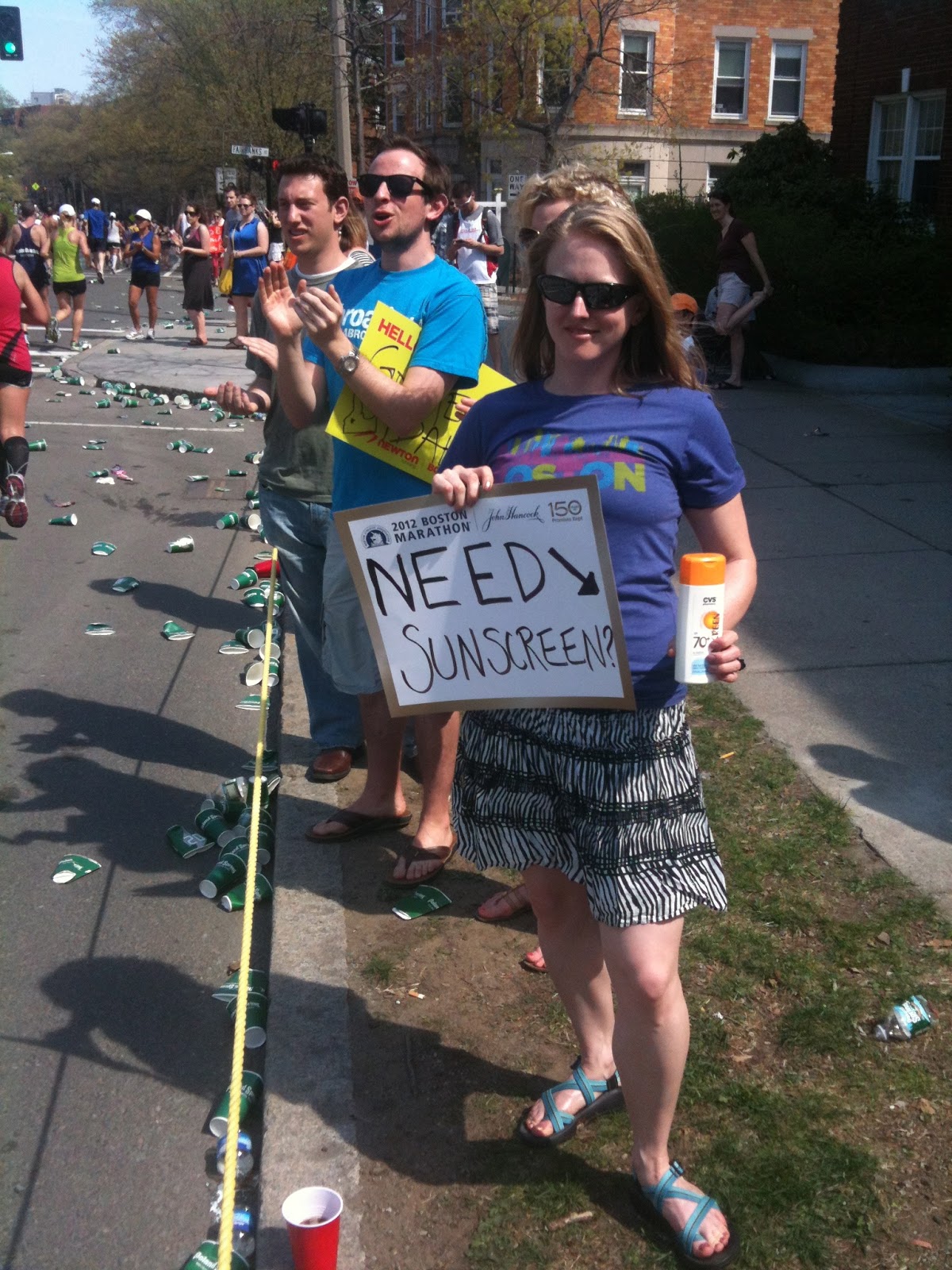
Then comes the day itself... Marathon Monday. There are always masses of bikers that wake up early and cycle the 26.2 miles to Hopkinton and back. I've never felt quite ready enough to do that in mid-April but I did bike 7.5 miles of the course out and back this morning, covering Heartbreak Hill and getting to Wellesley and back. It was fun seeing all of the spectators getting their chairs set up, seeing the volunteers prepping the water station, the kids writing on the streets with sidewalk chalk. After the bike ride I got to relax and cheer on the 27,000 runners from mile 23. I gave out sunscreen, my friends gave away free popsicles, and we helped a runner or two who needed some extra support.
Always trust a pale girl to bring the SPF 70 to the party

All-in-all it was an exhausting weekend - and I didn't even run the marathon! But it was well worth it. If you're curious about how many calories working at an expo, biking part of the marathon course, or cheering for hours can burn, stay tuned for an upcoming post because I had my metabolic armband on through it all... And if you're interested in trying to qualify for Boston, the guy behind No Meat Athlete has a new business called Run Your BQ (Boston Qualifier). Good luck!

Tuesday, April 10, 2012

What's In What You Eat?

Confession: I'm stealing this post idea from Hungry For Change, or Take Part Food as they're calling themselves these days. They posted this clip from SNL about "Almost Pizza" and I thought it was worth passing along:


Have you thought recently about what exactly goes into the food that you buy prepackaged? Something like pizza, you'd assume would have the typical crust ingredients like flour, toppings like cheese, veggies, etc. While it might not be able to walk under the fridge like the one in the clip, take a look next time you're in the freezer section; you'll find ingredient lists that read like a novel.

And while we're on the subject of frozen pizza... there are redeeming qualities to some frozen pizzas such as the calcium from the cheese, the vegetables (if there are vegetables), the iron from the meat. But pizza should only be a "sometimes food" (as Elmo would say), not an "anytime food" because in addition to those redeeming qualities you'd be hard pressed to find a frozen pizza that is not loaded with saturated fat and sodium; and that's if you only eat what they deem is one serving. For example, the Freschetta Three Meat Medley Pizza considers 1/5 of the pizza a serving and in that one serving you'll get 930mg of sodium (~39% of your daily allowance) and 7g of saturated fat (~35% of your daily allowance). So if you eat two or three pieces... you can see where I'm going with this. But if you want to eat frozen pizza once in awhile, go for it - just try to get the thin crust style with veggies. And in case you're wondering, there's plenty of white flour and calories in the pizza, so you can bypass those that come with bread sticks, wings, or cookies in addition to the pizza (YIKES!).

UPDATE: Just saw on the news that in the UK Pizza Hut is unveiling pizza with a hot dog stuffed crust. Thoughts?

Monday, April 9, 2012

Finding the Right Fit

Does your bike fit you? Chances are if you can move the seat post up or down until your feet reach the pedals, your answer is yes. But have you ever actually gotten a bike fit to you? Bike fittings can be pricey, but they can save you a lot of pain throughout the season. A few telltale signs that you might need a bike fitting are: a sore lower back, tight shoulders, numbness in feet or hands while biking, and knee pain. Bike fittings range from the basic, where a trained professional will hold a string with a weight up to your hip in order to make sure that the positioning is correct, to the extremely advanced which utilize cameras and computers.

I was lucky enough to get a glimpse of this fancier type of fitting a few weeks ago at the Multisport Expo. Wheelworks, the bike shop that sponsors my triathon team, was demo-ing the Retul bike fitting. According to the website, "Retül technology is a cycling-specific motion-capture bike fitting system designed to provide qualified bike fitters highly accurate and comprehensive bike fit data. The system incorporates three-dimensional measurement, immediate report capability, and a millimeter-specific digitizing tool to provide the most accurate dynamic fitting solution in the industry."

My experience was fun; the trained Wheelworks employee first stuck little velcro dots on some specific points on my body (shoulder, elbow, wrist, hip, knee, ankle, etc), then velcroed the LED markers onto those dots (markers were connected to each other and attached to a battery pack). A few feet away was a sensor bar. The fitter could then look at his laptop and gather all sorts of data about my fit as I pedaled. I got to see an image of myself as a stick figure, with each LED marker showing up on the screen and little lines connecting those dots. I also saw an image of my knee strokes; the further apart the two lines, which represent your leg pushing down and pulling up, the worse your form. My lines were very close together which indicated that I don't change position much from the upstroke to the downstroke.


It turns out my fit is pretty good already (not a big surprise since I don't have much pain when I ride) so I didn't need too much tweaking. He did suggest a shorter handle bar in order to get a better angle when I'm riding with my hands near the brakes (as in the picture, above). He also suggested that I buy a foam roller since it hurt a lot when he pushed into my hip trying to find the specific area of my hip he needed to place the velcro.

Spring is a great time to get a tune up and fit before beginning to log serious miles on your bike. If you'd like a retul fit and you're in the Boston area I highly suggest Wheelworks. The retul website has a function where you can search for certified fitters in your area. Or, if you're thinking of something a little less fancy, call your local bike shop and ask if they have any fit specials going on. Your body will thank you!

Monday, March 19, 2012

Antioxidant Power House? Okie Dokie, Artichoke(e)!


My brother Erik and I recently decided to take a trip to California to visit our relatives. We wanted to add on a couple of days in a new locale and, based on tips from friends, settled on Big Sur, a region about 150 miles south of San Francisco and 300 miles north of Los Angeles. Not exactly big on planning ahead, we were chatting with family members the day before driving down about what our route should be. That's when I got some amazing news: directly on our way we would be passing through Castroville, the ARTICHOKE CENTER OF THE WORLD!!! I love artichokes. Growing up we would have them in the summer, steamed to perfection. We'd rip off the leaves, dip them in globs of mayonnaise, then carefully scrape off the weird hairy part to devour the heart. True, mayonnaise is not great for you. But cooked artichokes, according to a sign in Castroville, have more antioxidants than any other vegetable! Well worth eating, though you may want to find a healthier alternative to the mayonnaise like olive oil or lemon juice.


Some other fun facts about artichokes:
They are low in calories but high in fiber and many other nutrients like phosphorus, vitamin C, magnesium, folate, and potassium. Additionally, they are technically a thistle which, if you're like me, you never really stopped to think about.

If you've ever gone to buy artichokes and thought that they looked a little bit dirty or bruised, chances are that it was merely "frost kissed" which apparently "turns green like unkissed chokes when cooked" and is "preferred by artichoke lovers." I'd love to see their supporting data and would happily volunteer for a taste test.

Some other fun facts about Castroville, CA:
If you love artichokes as much as I do, you can go to the artichoke festival held there every year right around my birthday (this year it is the weekend of May 19-20). During this weekend you can make 3-D "agro art" out of fruits and veggies, eat artichokes in almost every form imaginable, go on a trip to an artichoke patch, etc.

There is a restaurant called the Giant Artichoke where they have an enormous artichoke perfect for photo ops and specialize in fried artichokes (they even sell them frozen so you can take them home). We got an artichoke sampler plate which featured a steamed artichoke, fried artichoke hearts, and artichoke bread which you'll notice came with an enormous scoop of butter (not pictured: mayo to dip the artichoke leaves in and ranch dressing to dip the fried artichokes in). Seems like maybe they could use an artichoke-loving RD on staff to help make the menu more healthy!

Monday, February 20, 2012

Full Up on Plant-Based Foods

None of us are sure exactly how it started - we were running stairs at Harvard stadium so I could track how many calories I was burning for my metabolic armband post. Someone mentioned that several people he knew were doing cleanses recently, I shared my opinion about the danger of cutting macronutrients out of your diet, and the next thing you know, the three of us were on a two-week long vegan cleanse*.

This was a lot easier for me than it was for either of them. I had already cut red meat and pork out of my diet and was a huge fan of tofu, legumes, and other vegan-friendly food products. Dan has a meat-share (like a CSA but with locally-raised meat) and Chris's breakfast routine every day includes two eggs. We sat at brunch that day after running the stairs eating eggs (me) and plenty of breakfast meat (them) going over what could and could not be eaten during these two weeks. Chris asked about bread (normally OK but check the package just in case) and we went over easy options for cooking at home (make sure to plan ahead) and eating out (Mexican and almost any type of Asian cuisine are the most likely to have options).

We all came out of it with mixed results, Dan making it the full two weeks despite his co-workers tempting him with copious amounts of Valentine's Day chocolate. Chris stopped early in order to get back to eating meat prior to joining Cross Fit (huge proponents of the Paleo Diet) and I did fine except for accidentally eating a handful of Cheetos halfway through the second week.

People often assume that you'll lose weight if you stop eating animal products, and I'm sure that a lot of people do (in fact, Dan did lose weight during the two weeks). For me though, I still ate just as many calories as I normally do, maybe even more because I constantly had a bag full of snacks with me in case I couldn't find any while out. It seems that many think of a vegan diet as being sparse, and in fact I've had people tell me that you "can't get full" on vegan food. True, there were times during the two weeks that I would've felt more full if I had been able to melt cheese on top of whatever I was eating, and I did get tired of the taste of soy milk, but besides that I ate some of the most delicious food I've had in a while. So for those who think of vegan food as nothing but bland tofu, mushy brown rice, and rubbery meat-replacement products, here were some of my favorite meals from the past two weeks....

Breakfast
Frozen hashbrowns sauteed in olive oil with wilted spinach, chipotle salsa, and lentils.
Whole-wheat tortilla with peanut butter and banana.
Steel-cut oats with maple syrup and walnuts.

Lunch
Whole-wheat tortilla filled with: brown rice, fire-roasted corn (comes frozen from Trader Joe's), avocado, cilantro, lentils, chipotle salsa.
Spinach salad with garbanzo beans, roasted red peppers, marinated artichokes, tomato, cucumber, and tabouli.
Whole-wheat tortilla filled with: white-bean hummus, chopped tomatoes, baby spinach, and falafel (frozen, again from Trader Joe's).

Snacks
I love Meatless Primal Strips and also ate plenty of my usual snacks (almonds, Luna bars, bananas, veggies and hummus).

Dinner
We had some great meals out including Grasshopper, an all-vegan Asian restaurant nearby, and True Bistro, an upscale vegan restaurant in Somerville.

As I mentioned earlier, Valentine's Day happened to fall during this two-week period and lucky for me I have a very understanding boyfriend who didn't mind helping me cook this delicious recipe for Polenta Lasagna with Portabellas and Kale that night. I was also helping out with data-collection in a school cafeteria on one of the days and after smelling lasagna all day had an intense craving. Fortunately, I was able to find this recipe which substitutes tofu for ricotta in a traditional lasagna and it really hit the spot!
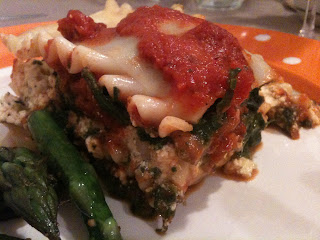
Vegan lasagna: healthy, filling, and delicious!
All-in-all it was really interesting to go vegan for two weeks in order to see all of the challenges that people can face. It made me value clearly-stated food labels and I did end up planning ahead more often in order to cook at home. Dan has said that the two weeks made him appreciate vegetables in a way that he never has before and while he's not about to give up his meat share, he's going to make an effort to eat a more plant-based diet, perhaps going vegan every other day. The vegan diet made Chris appreciate what vegans go through, especially when eating out and he was excited to find some new recipes (like a vegan chili) to work into his normal routine. As for me, this morning I was back at my old habits eating cheese on my english muffin. What can I say, despite loving the concept of better health through a plant-based diet, I'm a Wisconsin girl through and through.

*I completely understand that people stop eating animal products for many different reasons and don't mean to imply that eating a vegan diet for two weeks is a trendy "cleanse" like an all-juice diet; we just called it a vegan cleanse because we were cutting out a normal part of our diet. I also don't mean to imply that animal products are toxins. This was just for fun.

Wednesday, February 8, 2012

The Truth is in the Metabolic Armband

If you're like me, you've probably done some sort of physical activity and thought to yourself afterward "gee, that must've burned a whole bunch of calories!" But how many? For a class last semester I got to wear a metabolic armband for 24 hours that tracked my calorie output (as well as my sleep quality, how many minutes of moderate and vigorous activity I did, and the number of steps I took). How does it do this? By strapping the band onto your upper arm, it measures "galvanic skin response" to see how much you sweat in addition to skin temperature, the rate at which heat is being dissipated, and, via the accelerometer, how much you're moving. I was so excited to get to use the armband but I had a hard time deciding which physical activity I wanted to do on my one day; it ended up raining so an hour and a half of hot yoga won out over other options. Still, I was itching to try out other activities.

Last week I was able to borrow the armband for a whole week for just this purpose. I had a couple of activities I knew I wanted to try and then I talked with friends and followers to see what activities they've been wondering about. When I could, I compared my armband results from those that either the machine indicated, a website calculated, or the instructor of the class estimated to see how accurate these tools are compared with the armband (which claims to be the most accurate armband on the market).

Here's what the Body Media website that the armband syncs to knew about me going into it: my gender (female), my hand (right), my height (5'3"), my weight (~130), and whether or not I am a smoker (no). Here are my calculations, I hope you find them helpful!

Monday
  • 3 mile walk to school (50 min): 228 cal  
Comparison: Shapefit.com estimates that a 130 lb person walking 4.0 miles per hour, which is a little faster than I was walking, can expect to burn 236 calories per hour.
  • 1 hour basic yoga class at South Boston Yoga which focused that day on hip opening: 141 cal

Tuesday
  • 3 mile walk to school: 223 cal
Comparison: Monday the same walk burned 5 more calories - maybe my backpack was heavier that day?
  • Sitting in an hour and a half long lecture having walked to school: 92 cal
  • 30 minutes on the treadmill, totaling 2.5 miles: 271 cal 
Comparison: The treadmill, knowing only my weight and age, told me I burned 294.4 cal.

Tuesday was the day I burned the most calories - by walking to school, running on the treadmill for 30 minutes during lunch, and walking to dinner and then the train later that night, I burned 2828 calories, took 22,513 steps, and had a total activity time of 276 minutes. Could it be because I had slept for 8 hours and 4 minutes the night before, with 94% sleep efficiency (time laying down versus time actually asleep) making it the best night of sleep I got all week? Perhaps!

Wednesday 
Day off! After awhile you don't really notice the armband during your daily routine and sleeping, but Wednesday I had ghost armband syndrome and kept thinking I was still wearing it.

Thursday
  • Sitting in an hour and a half long lecture having driven to school: 85 cal
Comparison: Sitting in the same lecture on Tuesday burned 7 more calories having arrived from walking rather than arrived from driving.
  • 1.5 hour boxing class at Boston Boxing and Fitness (mix of jumping rope, weights, sparing, step-ups, push-ups, lunges, etc): 434 cal
Comparison: Shapefit.com estimates 354 cal/hr of "boxing, punching bag" but that jumps to 531 if you're "boxing, sparring" and 708 cal/hr if you're "boxing, in ring, general." 

Friday
  • Spin class at Sweat and Soul, 45 minutes long on Real Ryder bikes: 226 cal
Comparison: The instructor estimated 800 when I asked him how many calories one could expect to burn; a Body Media rep says via e-mail "When using certain gym equipment you may notice that your overall armband information may be lower than it should be. This is due to the fact that the abnormal and usually smooth motions throw off the accelerometers in the armband. Different equipment can affect the overall accuracy of the armband in many different ways." I think that the number is on the low side, but it was also only a 45 minute class and I wasn't panting, though I did sweat completely through all of my clothes so maybe a more accurate estimation would be around 300 calories.
 

Note: These Real Ryder spin bikes are pretty cool. They're supposed to mimic real riding on the road so they move to the left and right - and you really have to engage your core in order to turn them. See the above video for an example. 

Saturday
  • Stair running at Harvard stadium (the little stairs that you use to enter the stadium, up one set and down the next around the entire stadium and back which took approx 25 minutes): 187 cal

Sunday
Comparison: The ZYP website says participants can "dance away their worries & 500-700 calories." Before I went to the class I never would've guessed that I would get such a good workout but you literally move (or shake) your whole body the entire time - so don't underestimate this as a really good full body workout.

Special thanks to Rachel, Lea, Barrett, Dan, Chris, and Meredith who suggested workouts and then kept me company (or brought me along)!

I'm planning on borrowing the armband again in the spring so that I can track calories burned for fun outdoorsy activities like cycling, hiking, and running. Is there an activity that you've always wondered about? (Besides swimming since you cannot submerge the armband.) Let me know in the comments section and I'll write about it next time! Interested in learning more about Body Media, how it measures calories burned, or how it compares with other armbands out there? Check out their comprehensive website.

Wednesday, February 1, 2012

It's February! Hearts Abound!

What a coincidence that on the first day of February, which is American Heart Month, I had my first day of rotations for my Clinical Nutrition class where we are counseling patients on the cardiac floor of a local hospital about the heart healthy diet. In honor of that, here are the five things that you (especially if you're at risk of heart disease) need to keep in mind in order to keep your heart healthy:
  • Keep total fats low. You can do this by eating lean protein and watching your consumption of fats like cooking oil and whole milk (for example).
  • Keep saturated fats low. You can do this by decreasing the amount of animal products you consume, especially things like red meat, pork, and cheese.
  • Keep cholesterol low. You can do this by limiting the amounts of animal products you consume such as egg yolks and certain types of meat and fish.
  • Keep sodium levels low. You can do this by eating less processed and prepared foods, cooking at home more, and being aware of sodium content and serving size.
  • Keep fiber levels high. You can do this by eating high-fiber cereal, beans, whole grains, and fruits and vegetables.
Want to get involved in heart healthy events? This Friday, February 3rd, is national wear red day put on by the American Heart Association. So put on your red dress, make heart-healthy choices in your meals and snacks, and celebrate the love.

How healthy is your heart?
(photo credit: http://www.freedigitalphotos.net/images/view_photog.php?photogid=1998)